My first language is English and so I mostly use it to communicate with people. However, being a non verbal communicator means that you have to actually learn how to communicate with me. I’m starting to see a few parallels between this learning process and the process of learning a foreign language. Therefore in this article I am going to discuss one of my favourite communication methods and how it works along with some of the feedback that I have gotten from multiple conversation partners over the years.
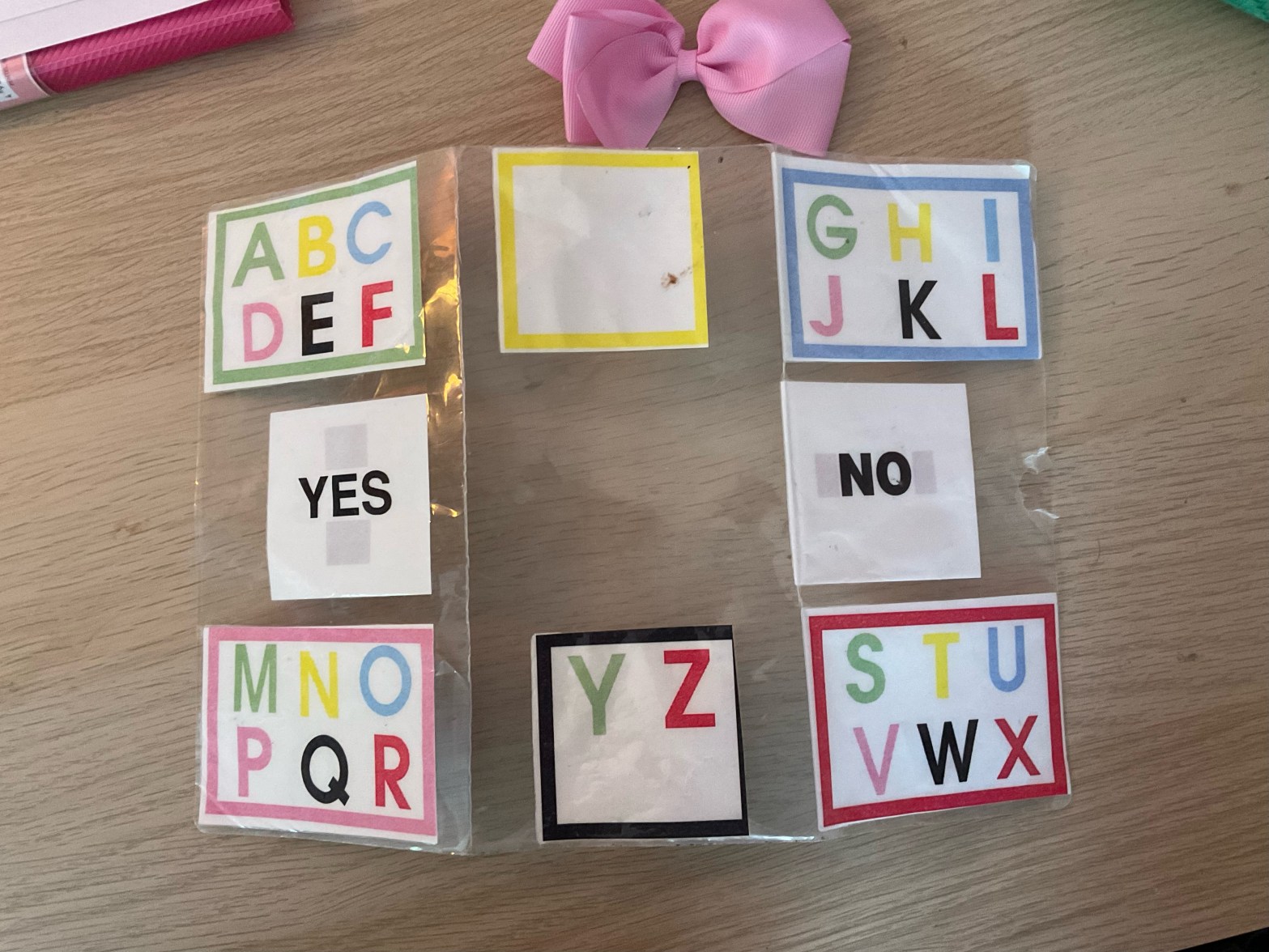
In my previous articles, I have discussed how I use my nose to type on my iPad. Although it is a very effective way to communicate detailed and accurate information, it is not always the most convenient way to communicate because I require a table to have it on so I can have a strong, stable writing surface. Because of this quite specific criteria, I often prefer to communicate using something that I call my Talk Sheet.
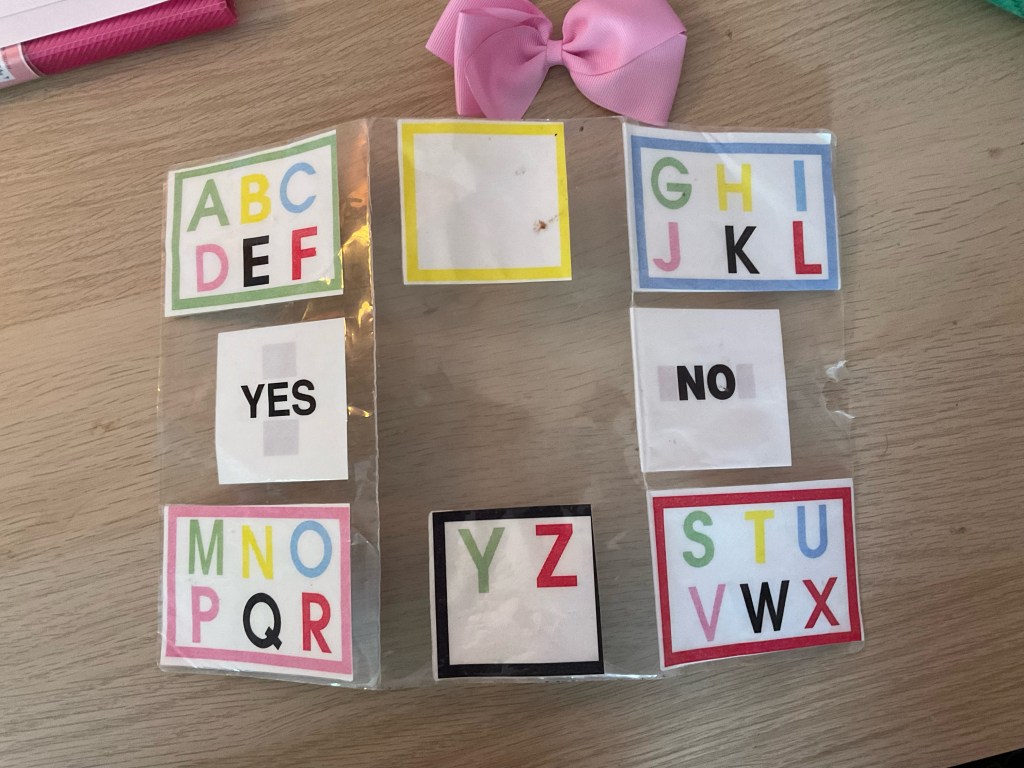
The Talk Sheet is a laminated A4 sheet with the letters of the alphabet grouped into 5 colour coded boxes, plus an extra yellow box to give me enough colours. In each box is 6 different coloured letters, each one is the same colour as a specific box. Picking a letter from the sheet consists of a seemingly simple 2 step process. First I look at a box to indicate the colour of the letter I want and then I look at another box to indicate which letter of that colour it is. For example, if I wanted the letter Z, I would first look at the bottom left box which has a red outline and then I would look at the bottom middle box because Z happens to be the red letter in that particular box.
A, I, P and X are particularly confusing letters because they are the same colour as the box that they are in. This means that when I pick any of these letters, my eyes don’t actually move! A very common mistake here, especially for beginners, is forgetting that some letters are the same colour as the box and wondering why I’m just staring at a box intently! To help with this, I nod when my conversation partner states the colour that I’m looking at to confirm that it is the correct colour and also to indicate that I’m now telling you the letter.
I have to repeat this process for every single letter so remembering everything that I have said can sometimes be a challenge. Most beginners prefer to write each letter down on paper or their phone. This is particularly useful for people with dyslexia because according to at least 4 people who have the condition, “trying to remember multiple letters at once is difficult because they get muddled up and you also start to forget the start of the word”. Experienced people can mostly do it in their head but most of them have been working on it for years.
I rarely just say one word, so to indicate a space, I stick both my arms out either side. This aspect is problematic for two reasons. Firstly, I don’t always remember to do it, sometimes I get so caught up in the conversation that I totally forget to do the sign! Secondly my conversation partner forgets that this sign actually exists because they are so busy remembering how to do it along with what I have said. Both of these incidences result in a long string of letters which nobody can understand.
I think that the worst mistake that people make is avoiding using the Talk Sheet because they are not good at it! Just like learning German, you can only learn the Talk Sheet if you practice it! You wouldn’t go to your first ever German class and then travel to Germany the next day and expect to be fluent, nor would you give up your German once you realise that you weren’t, would you? Just as you would keep practicing and practicing your German until you were fluent, so too do you need to adopt the same attitude when you are learning the Talk Sheet.
I do let people predict the word that I’m going to say, for example , if I have already said the letters D and O, you might say dog and I would either nod to confirm that I am indeed saying dog, or shake my head to indicate that I am in fact saying a different word that happens to begin with D O, for example Doc Martens. You can also guess the word from the context of the conversation. If you have just asked me about my favourite animal, I am more likely to be saying dog rather than Doc Martens which would be an appropriate guess if you had just asked me what shoes I wanted to wear. Whilst predicting single words is acceptable and actually quite a good way to save time, one of my greatest bugbears is when people attempt to guess the entire sentence that I am trying to say! These people are hardly ever right and it also kind of takes away my own voice because I tend to have quite an unique turn of phrase!
In conclusion the Talk Sheet can be quite easy for the keen, committed and patient person to learn. As with all foreign languages, it does take a bit of time to get the hang of but once you learn how to do it, it’s an indispensable tool to communicate with me!
Eemmcg💜
 The Non Verbal Linguist